
We Can Do Better Than This
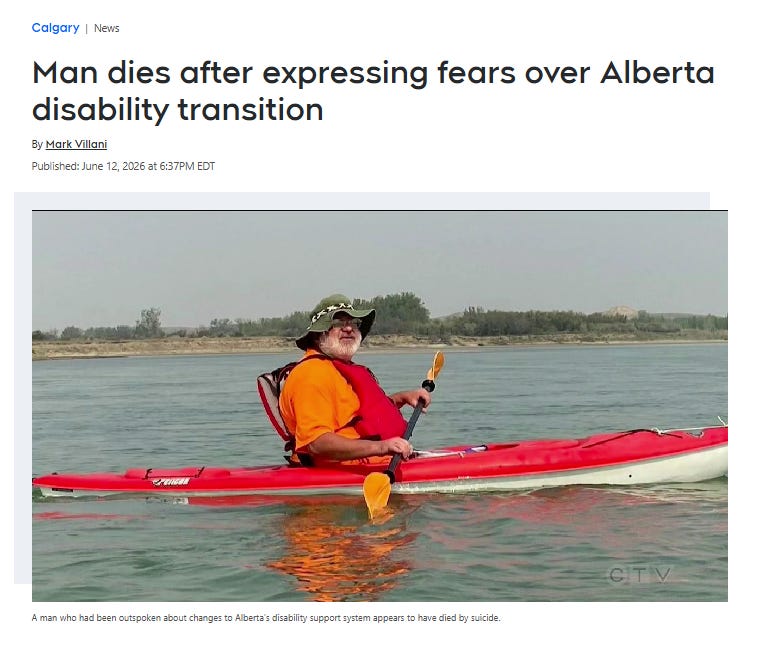
Alberta Man Takes Life Due to AISH Changes

A man in Alberta is dead.
According to reports, he left behind notes and letters expressing fear about the Alberta government’s plan to move people from AISH to its new Alberta Disability Assistance Program, known as ADAP.
The details of his death are heartbreaking.
But what has stayed with me most is this: people in Alberta’s disability community have been warning us for years that this transition would create fear, uncertainty, and hardship.
And too many people weren’t listening.
For those unfamiliar with the issue, AISH stands for Assured Income for the Severely Handicapped. Nearly 80,000 Albertans rely on the program.
The Alberta government is replacing much of AISH with a new program called ADAP.
The government says the goal is to create a system that better supports employment for people with disabilities who are able to work.
Many people in the disability community see something very different.
They see a government looking at some of Alberta’s most vulnerable residents and asking them to prove, once again, why they deserve support.
They see more bureaucracy.
More uncertainty.
More stress.
And for many, less money.
AISH recipients currently receive approximately $1,940 per month.
That amount already leaves many people living below the poverty line.
In Calgary, the poverty line is roughly $29,000 per year. AISH provides less than $24,000 annually.
We already expect tens of thousands of Albertans with severe disabilities to survive on incomes below what experts consider the minimum required for a modest standard of living.
And now many of those same Albertans are being told they may receive even less support unless they navigate a complicated reassessment process.
Some government officials have argued that many people currently receiving AISH are capable of working.
Perhaps some are.
But I have spoken with numerous people receiving disability benefits who desperately want to work and have applied for hundreds of jobs without success.
Finding an employer willing and able to accommodate a disability is not always easy.
In some communities, it is nearly impossible.
I recently spoke with a woman who uses a wheelchair and lives independently.
She told me that even accessing a food bank can be incredibly difficult because she has no public transportation available where she lives.
Imagine that reality.
Imagine being told to become more self-sufficient while struggling to access basic necessities.
Imagine being told to find work when you cannot reliably access transportation.
Imagine worrying every month about whether you can afford food, medication, rent, or utilities.
The disability community faces challenges that many Albertans never see.
Isolation. Loneliness. Depression. Anxiety.
A lack of accessible transportation.
A lack of affordable housing.
A lack of opportunities to build community and social connections.
Many people with disabilities would love to live more independently, participate more fully in society, and contribute in whatever ways they can.
But those opportunities often require resources they simply do not have.
When you are living in poverty, everything becomes harder.
Getting groceries becomes harder.
Finding transportation becomes harder.
Maintaining friendships becomes harder.
Participating in your community becomes harder.
Protecting your mental health becomes harder.
And that is why this conversation is about much more than a government program.
It is about dignity.
It is about whether people feel valued.
It is about whether people believe society sees them as human beings deserving of support and compassion.
What makes this situation particularly difficult to understand is that Alberta is not a poor province.
We are the wealthiest province in Canada.
At the same time the government is spending public resources preparing for a separatist referendum that many Albertans do not want, and spending taxpayer dollars fighting legal battles related to that referendum, people with severe disabilities are being told they may need to survive on even less.
A society is ultimately judged by how it treats its most vulnerable members.
Not by how it treats the wealthy.
Not by how it treats the powerful.
Not by how it treats those who already have every advantage.
But by how it treats those who need help.
We should be doing everything possible to lift people out of poverty.
We should be investing in accessibility, housing, transportation, community supports, and mental health services.
We should be making life easier for people living with disabilities, not harder.
Most importantly, nobody should ever feel that their only option is to leave us.
As Albertans, and as Canadians, we can do better than this.
We must do better than this.
So what do we do about it?
First, we refuse to look away.
We talk about these issues with our friends, our families, our neighbours, and our coworkers. We make sure people understand what is happening and who is being affected by these decisions.
We get involved in our communities. We volunteer. We organize. We support disability advocates and community organizations that are doing the work government should be doing.
And if you have the financial means, support the people and organizations fighting for a more compassionate Alberta. Support independent voices fighting for better. Support advocacy groups. Support political movements that are committed to lifting people out of poverty instead of pushing them deeper into it.
Most importantly, we remember that governments are not permanent.
Every government can be challenged.
Every government can be replaced.
Change happens when ordinary people decide they have had enough and are willing to do something about it.
The future of Alberta will not be decided by politicians alone. It will be decided by the people who choose to speak up, get involved, and fight for a province where dignity, compassion, and opportunity are available to everyone.
Thank you for such a compassionate perspective on this. I am so ashamed of this government, that the only way this man could see going forward was to end his life. He mattered and so did his life and how he lived it. It is reprehensible that it comes as an outcome of this government’s policy and ideology. They are a cruel, uncaring group of people. I would like to see how successfully they could live on the AISH income and how anxious they would be if they had to move onto ADAP. It is degrading and disgusting that the government treats its most vulnerable citizens this way.
Critically Important article Cole, so moving and frustrating.
The whole UCP Government should be forced to spend a week wheelchair bound.
And then be kicked the hell out.
Heartless bastards...!